Municipal and regional assessment of “quiet areas” in Sweden
Human impacts Comments Off on Municipal and regional assessment of “quiet areas” in Sweden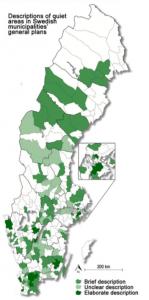 A new paper from Sweden presents a compelling overview of efforts made by regions and municipalities in that country to identify areas that are relatively free of human noise. While these efforts have had only modest impact on planning and regulation, in a few cases quiet areas are being protected from noisy development or highlighted in recreational promotion. This sort of initiative deserves to be more widely replicated.
Any local planners or activists who would like to encourage quiet-area expansion and protection will find a wealth of references here, and will appreciate the case reports describing some of the criteria being used in various cities, towns, and counties. The paper is open-access and can be readily downloaded as a PDF or html.
The authors found that 41% of Swedish municipalities include quiet areas in their general plans (all shades of green on map at left), but only 6% (dark green) have created detailed assessments or strategies for implementation.
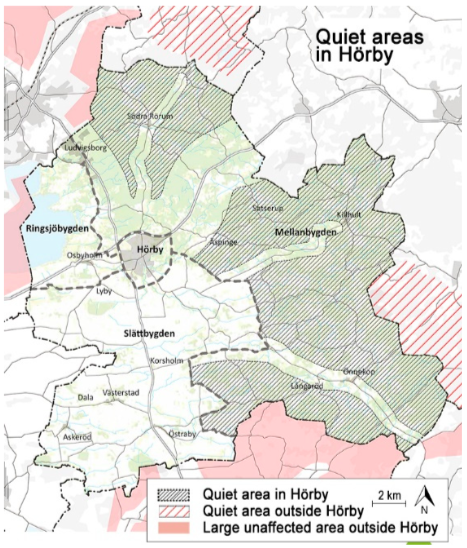
Here’s an example of a map produced by the city of Hörby, where the local general plan “includes a detailed account of how the quiet areas are to be protected. For instance, wind farms, shooting ranges, sawmills, and similar activities are to be avoided.” Other towns have also aimed to concentrate noisy activities away from currently quieter areas.
The authors examined ten regional initiatives and forty-three municipal projects in some detail, including looking at the criteria used for classifying various degrees of “quiet area,” which generally ranged from very quiet rural settings (25-35dBA) to parks in urban areas with noise levels that were relatively modest compared to the surrounding neighborhoods (perhaps 45dBA, with varying standards for times above this level based on local context).
Since 2013, three municipalities have replicated a Stockholm initiative, a local “Guide to Silence,” the most active outreach thus far undertaken, which emphasizes accessibility and the publication of maps, guides, and signs at quiet locations. Relatedly, three coastal Swedish counties have pioneered “Consideration Areas,” where visitors are encouraged to minimize their noise in designated archipelagos, for example by slowing boats and avoiding noisy activities. While having no legal force, reports indicate that collaboration and common goodwill have made these efforts quite successful.
Still, the authors note that “in many cases where mapping of quiet areas had been performed, it has been used mainly as an inventory,” with little or no followup in the ten or fifteen years since the initial mapping. Clearly, there is much more than can be done to move these ideas forward and establish relative quiet as a resource that is worth protecting and expanding. This paper is a very useful starting point for learning more about the possibilities and potentials of quiet area planning.
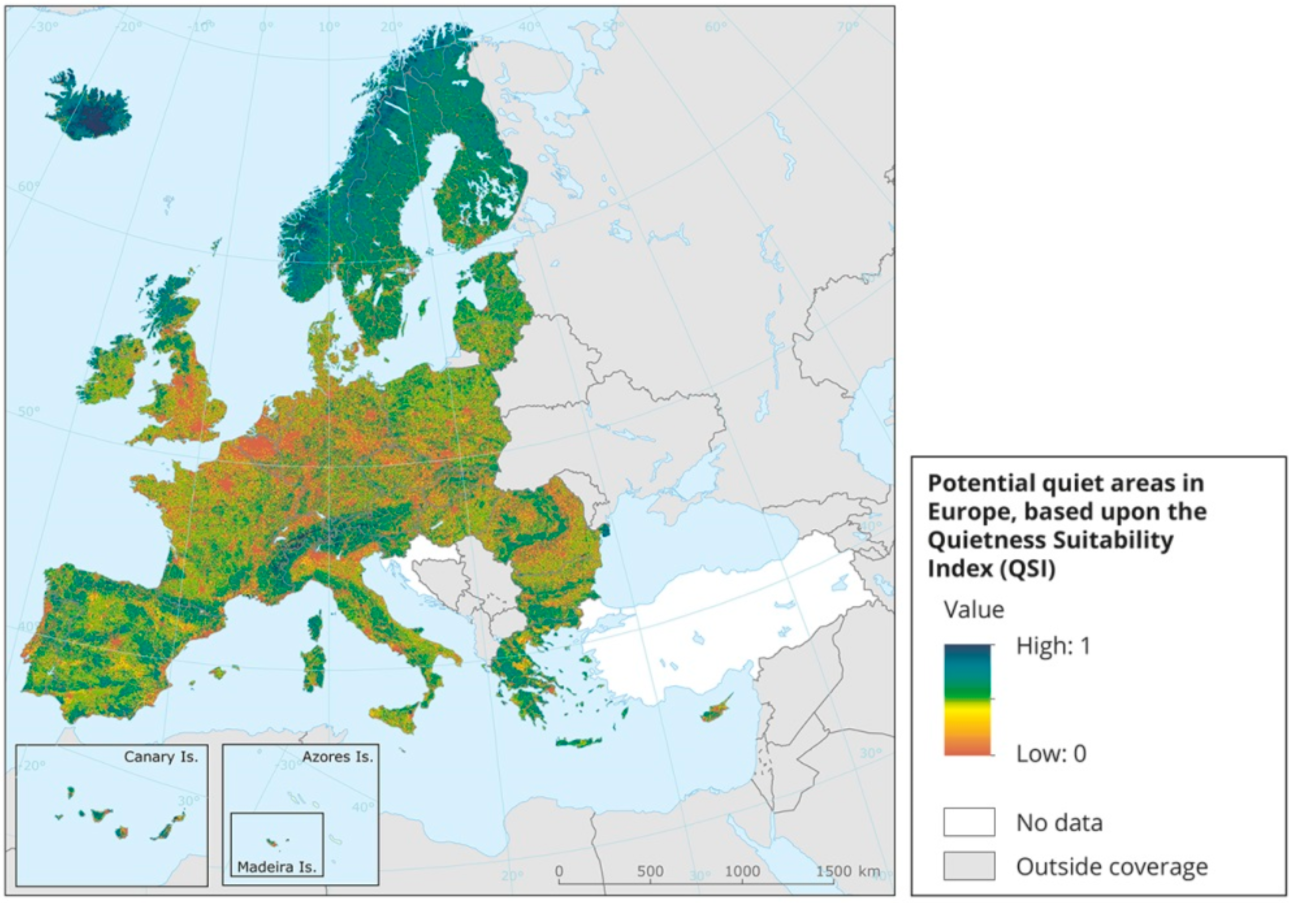
As a final bit of inspiration, here’s a map of European “potential quiet areas,” which highlights the pressing need to identify and protect what quiet places remain, especially in and around developed areas. You can click on this map to view a larger version that gives a better sense of the many tiny pockets that deserve our attention ASAP; while the US, mapping by the National Park Service finds similarly tenuous pockets of quiet in federal, state, and local public lands that should be prioritized for protection.

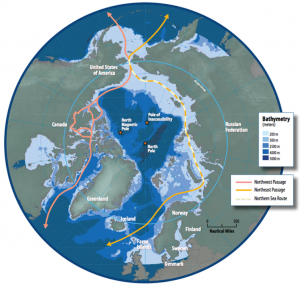 With the retreat of sea ice, both the Northwest Passage (along Canada’s northern coast) and the Northern Sea Route (along Russia’s northern coast) are seeing increases in commercial and fishing vessel traffic. While the first
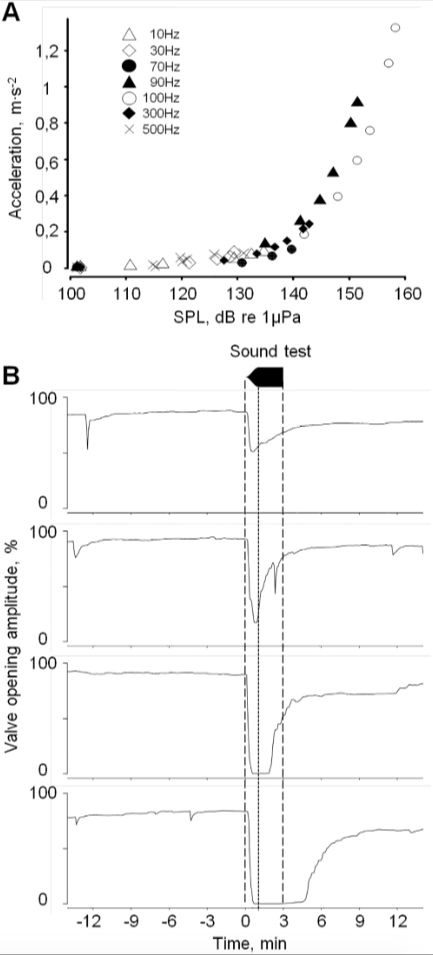
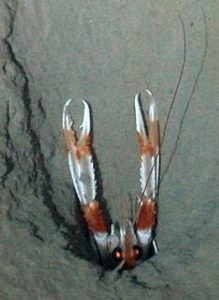 The Leighton and Hauton study, using sound playbacks mimicking a ship at 100 yards and wind farm construction at 60 yards, found that both lobsters and clams changed their digging behaviors, and triggered changes in their overall activity level (lobsters increased, clams decreased); they found no marked effects on brittlestar activity.
 They look small, about the size of a “cherry bomb” firecracker. They’re legal, exempt from the Marine Mammal Protection Act thanks to their functional purpose: protecting fishermen’s nets from seals and cetaceans poaching their catches, including squid, anchovies, and tuna.
 Clark County SD is in a legal battle over its decision to increase wind turbine setbacks from 2000ft to 3960ft (three-quarters of a mile). The Clark County Commission approved the 400MW Crocker Wind Farm, but based on local experience with a smaller wind farm, decided that more distance was needed between turbines and non-participating homes. As reported by the Watertown Public Opinion:
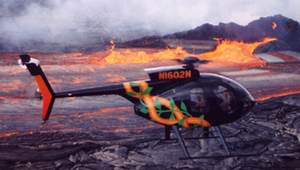 After seventeen years of obstructionism, the Federal Aviation Agency (FAA) is being sued for effectively ignoring a law requiring the development of air tour management plans (ATMPs) for National Parks. The National Park Air Tour Management Act of 2000 requires the FAA and National Park Service (NPS) to prepare an air tour plan for any park with over 50 flights per year, or develop voluntary agreements with air tour operators. Since then, the National Parks Overflight Advisory Group (NPOAG), which includes representatives from the FAA, NPS, air tour industry, and environmental groups, has been
 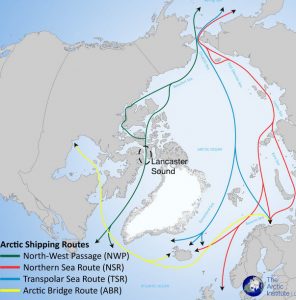 The so-called Northern Sea Route (or Northeast Passage) will benefit from Russia’s fleet of forty icebreakers and eleven Arctic ports; by contrast, there are no Arctic ports on the US/Canadian coastline (one deep in Hudson Bay closed last year). Rob Heubert, a former member of Canada’s Polar Commission,
 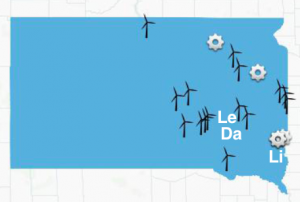 South Dakota has the nation’s 4th-best wind resources, and wind is currently the source of 30% of the energy produced in the state, the 2nd highest proportion the nation—yet it lags behind
  A nine-year court battle over motorized recreation in Utah’s red rock country has ended with
  On the other side of the table, Paul Turcke, the attorney for off-highway vehicle groups, said, “We’re not turning cartwheels over this, but given the alternatives and given the fact that we could participate effectively and make positive changes to this agreement, we think it’s the best option for moving forward.” Motorized recreation enthusiasts applauded the lack of any immediate changes on the ground; no routes were closed as part of the settlement, though some are likely to be shut down during the renewed planning process. Turke notes, “Everyone gets a fair shake in the future process and they can challenge the outcome if they choose.”
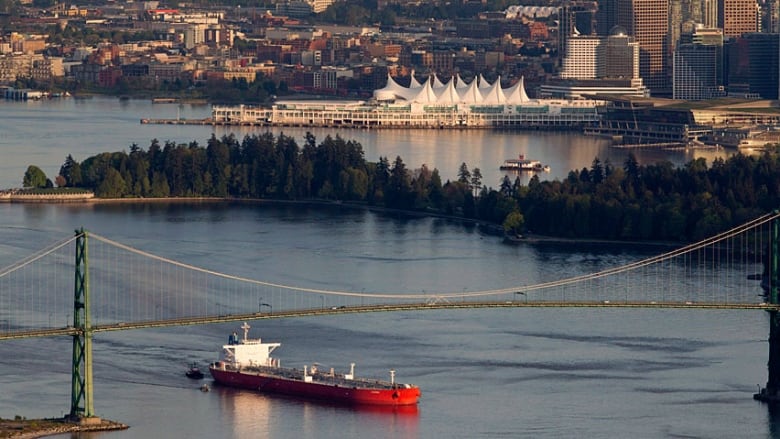
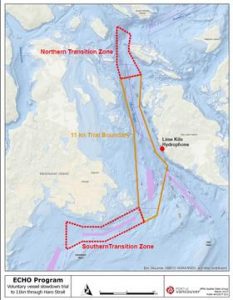 Haro Strait is a narrow passageway between Canada’s Vancouver Island the American San Juan Island, and is a prime summer feeding ground for the resident orca population, which has dwindled to less than 80 members. The voluntary speed restrictions will ask all ships to slow to 11 knots (about 13 mph) through a 16-mile corridor; cruise ships and container ships often run at 18-20 knots, while bulk carriers travel at 13-15 knots. The slowdown will reduce the noise of each ship as it passes by 40% or more, though it will linger in the area a bit longer; the net effect is expected to be beneficial by reducing the degree of impact on animals in the region.
 The recent