AEI lay summary of:
Goldbogen JA, Southall BL, DeRuiter SL, Calambokidis J, Friedlaender AS, Hazen EL, Falcone EA, Schorr GS, Douglas A, Moretti DJ, Kyburg C, McKenna MF, Tyack PL. 2013 Blue whales respond to simulated mid-frequency military sonar. Proc R Soc B 280: 20130657. http://dx.doi.org/10.1098/rspb.2013.0657 (download here)
and
DeRuiter SL, Southall BL, Calambokidis J, Zimmer WMX, Sadykova D, Falcone EA, Friedlaender AS, Joseph JE, Moretti D, Schorr GS, Thomas L, Tyack PL. 2013 First direct measurements of behavioural responses by Cuvier’s beaked whales to mid-frequency active sonar. Biol Lett 9: 20130223. http://dx.doi.org/10.1098/rsbl.2013.0223 (download here)
Results from studies off Southern California have quantified for the first time the reactions of Blue whales and Cuvier’s beaked whales to simulations of naval mid-frequency active sonar. In both cases, scientists found that whales tended to move away from sonar signals, and appeared to suspend feeding activity for an hour or more at times.
The Cuvier’s beaked whale results marked the first time this species had successfully been monitored during a controlled exposure to sound while wearing a temporary suction-cup “D-TAG” that allows researchers to track animal dive and movement patterns while also recording the sound level of the sonar signal that the animal is hearing. As with similar experiments done on other species of beaked whale, the two whales tagged in this study changed their normal dive patterns, paused or stopped echolocating for food, and waited longer at the surface after the sonar sound ended before they began diving normally again. The pause in foraging lasted for 6 hours in one whale, and at least 90 minutes for the other.
The whales’ behavior was changed at sound levels (89-127dB) that are far below the levels typically considered problematic by regulators (typically 160-180dB; though some Navy EIS’s use 120dB for beaked whales, because of their previously observed noise sensitivity).
CORRECTION, 1/31/14: The current round of Navy EISs and NOAA permits consider exposures down to 120dB in their analysis of behavioral “takes” for all species.
Researchers concluded that “The observed responses included vigorous swimming and extended time without echolocation-based foraging, imposing a net energetic cost that (if repeated) could reduce individual fitness.” While they did not see rapid ascents from dives that would support an early theory that some beaked whales may suffer tissue damage similar to what human divers experience as “the bends,” they suggest that the disruption of normal dive and surface-resting patterns could affect the animals’ dive metabolism in ways we don’t yet understand. Also of interest in this study was an unexpected period during which a tagged animal was exposed to sound from a distant (over 100km) naval exercise; in that case, the animal showed no response, though received levels were similar (78-106dB); researchers suggest that the animals could tell that these signals were much more distant than the test signals, which were under 10km away.
The Blue whale results were a bit more ambiguous, as there was significant individual variation among the 12 whales that were tagged and exposed to sonar-like sounds. Some whales were foraging at the surface, some were deep-diving feeding, and some were diving but not feeding. Whales at the surface showed little response, while diving animals reacted more strongly, including some instances of clear avoidance (i.e., swimming away, or “horizontal displacement” in the research parlance).
While the Blue whale results were not as uniform as the Cuvier’s results, this is the first time that blue whales have been studied to see how they respond to mid-frequency sonar, and the researchers consider even the modest effects to be significant, especially since blue whale populations are not rebounding similarly to other large whales. As the researchers conclude: “our results suggest that frequent exposures to mid-frequency anthropogenic sounds may pose significant risks to the recovery rates of endangered blue whale populations, which unlike other baleen whale populations (i.e. humpback, grey and fin whales), have not shown signs of recovery off the western coast of North America in the last 20 years.”
Using a complex set of measurements of 54 behavioral metrics (including such factors as orientation angle to the sound, change in pitch or angle of descent or ascent, and the number of lunges per dive), and applying a statistical formula that resulted in the average “response” ratings on the left axis of the charts below, researchers found statistically significant changes three key areas. The chart below shows the clear, yet subtle, changes in dive patterns (a), body orientation (b), and horizontal displacement (c), especially among the deep-feeding animals:
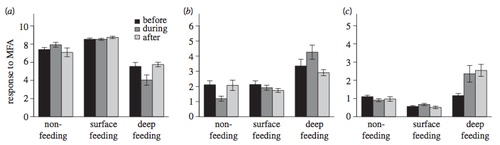
Researchers note that the whale that showed the largest reaction stopped feeding as soon as hearing the sonar signal and swam away from the sound; it did not begin feeding again for an hour, during which time it would have eaten over a ton of krill, which is about the minimum amount a whale needs per day (i.e., it’s a metabolically significant loss).
The responses noted occurred at average peak received levels of 130-160dB, again, notably lower than most regulatory thresholds for behavioral responses, which range from 160-180dB. CORRECTION, 1/31/14: The current round of Navy EISs and NOAA permits consider exposures down to 120dB in their analysis of behavioral “takes” for all species; in fact, the bulk of behavioral responses for “low frequency cetaceans,” such as blue whales, is expected at exposures similar to those here. There was a large range of response ratings for both dive patterns and body orientation (the chart above shows the average among all individuals); the avoidance responses showed a more modest range of variability, except for the one extreme response noted above. Overall, the results confirm previously-observed importance of behavioral context: “Since some of the most pronounced responses occurred near the onset of exposure but other, higher level exposures provoked no response, the data suggest that the use of received level alone in predicting responses may be problematic and that a more complex dose – response function that considers behavioural contexts will be more appropriate. Management decisions regarding baleen whales and military sonar should consider the likely contexts of exposure and the foraging ecology of animals in predicting responses and planning operations in order to minimize adverse effects.”


 The recent Presidential Executive Order Implementing an America-First Offshore Energy Strategy explicitly calls for the Secretary of Commerce to “take all steps permitted by law to rescind or revise” NOAA’s Technical Guidance for Assessing the Effects of Anthropogenic Sound on Marine Mammal Hearing. This planning document was the result of many years of collaboration among regulators, research scientists, environmental organizations, and the primary ocean noise-makers (oil and gas interests and the Navy). As OCR’s Michael Stocker notes, “All of this work threatened with a stroke of a pen…”
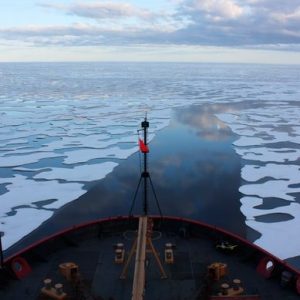 In yet another unforeseen consequence of global warming, scientists have begun charting the extent of a new underwater sound channel in the Beaufort Sea north of Alaska. As
 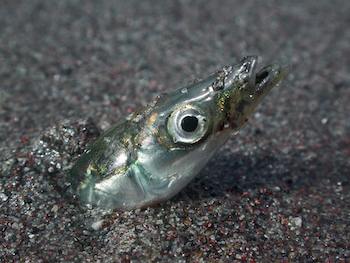 A new study looks for the first time at the impact of human noise on an important type of humpback whale foraging activity, bottom-feeding on sand lance. The research took place in the Stellwagen Bank National Marine Sanctuary in the southern Gulf of Maine, where humpback whales routinely do deep dives at night, rolling to their sides when they reach the bottom to forage for the small fish.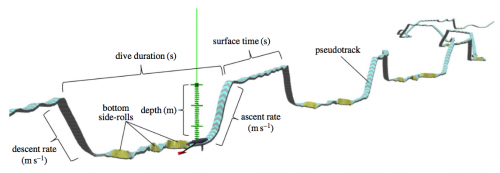
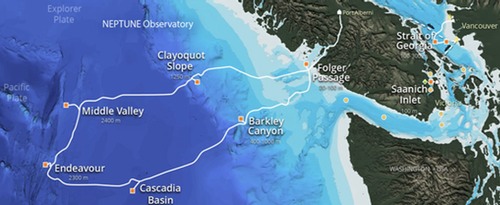
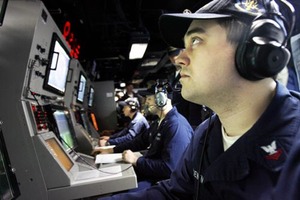 But while scientists are keen to hear what the new undersea recordings have to tell us, the US and Canadian Navies are far less enthusiastic. They’re concerned that the audio feeds, which are freely available to scientists and the public as downloads and via live online feeds, will reveal sensitive information about submarine and ship movements, navy training activities, and even the sound signatures of individual vessels. The two navies have arranged with researchers to have an audio bypass switch that allows them to divert the audio streams into a secured military computer—sitting in a locked cage at the research facility where the data comes ashore—at times when their ships are nearby (and also at some random other times, so that their diversions don’t give away any secrets on their own!).
 Immediately after NOAA’s approval, environmental organizations
  For the first time, a mass stranding appears to have been triggered by a relatively high-frequency mapping sonar; most previous strandings (though rare) have been associated with mid-frequency military sonars. An international, independent scientific review panel (ISRP) of five well-known marine mammal researchers has concluded that a 2008 stranding event on the northwest coast of Madagascar was likely precipitated by an avoidance response to a multi-beam echo-sounder system (MBES) being used to map the seafloor.
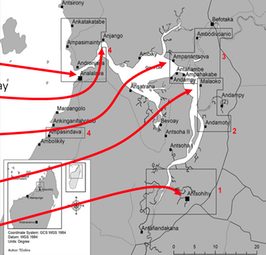 Acoustic modeling suggests that the whales would have been able to hear the MBES signals for at least 30km from the survey vessel, to near the island seen on the map to the right, 25km offshore, at which point they apparently continued moving toward shore until straying into the stranding zone. Why the animals continued moving inshore after the sonar was no longer audible is unclear. This is a species that normally lives only in deep waters; once the whales moved past the cliff near the survey area and into shallow shelf waters, they may have been quite confused, and further behavioral anomalies (including ending up in the estuary) may be unrelated to the survey sounds.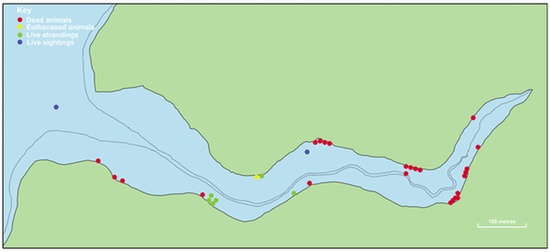
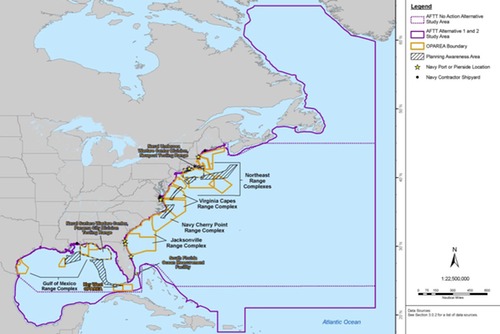
 In December, NOAA
  While the
  A Canadian frigate used its mid-frequency active sonar this week during a training exercise in Haro Strait, north of San Juan Island and south of Vancouver Island. The sonar emissions from the HMCS Ottowa (right) were picked up by whale researchers at Beam Institute, who raised concerns about sonar use in an area designated by the US as critical habitat for orcas. You can read a detailed report from Beam, including sonograms and MP3 files of the sounds heard,